Stop Guessing.
Start Reading.
The beginner's guide to the "AimPoint Express" green reading method—and why your feet are better than your eyes.
Why Eyes Lie
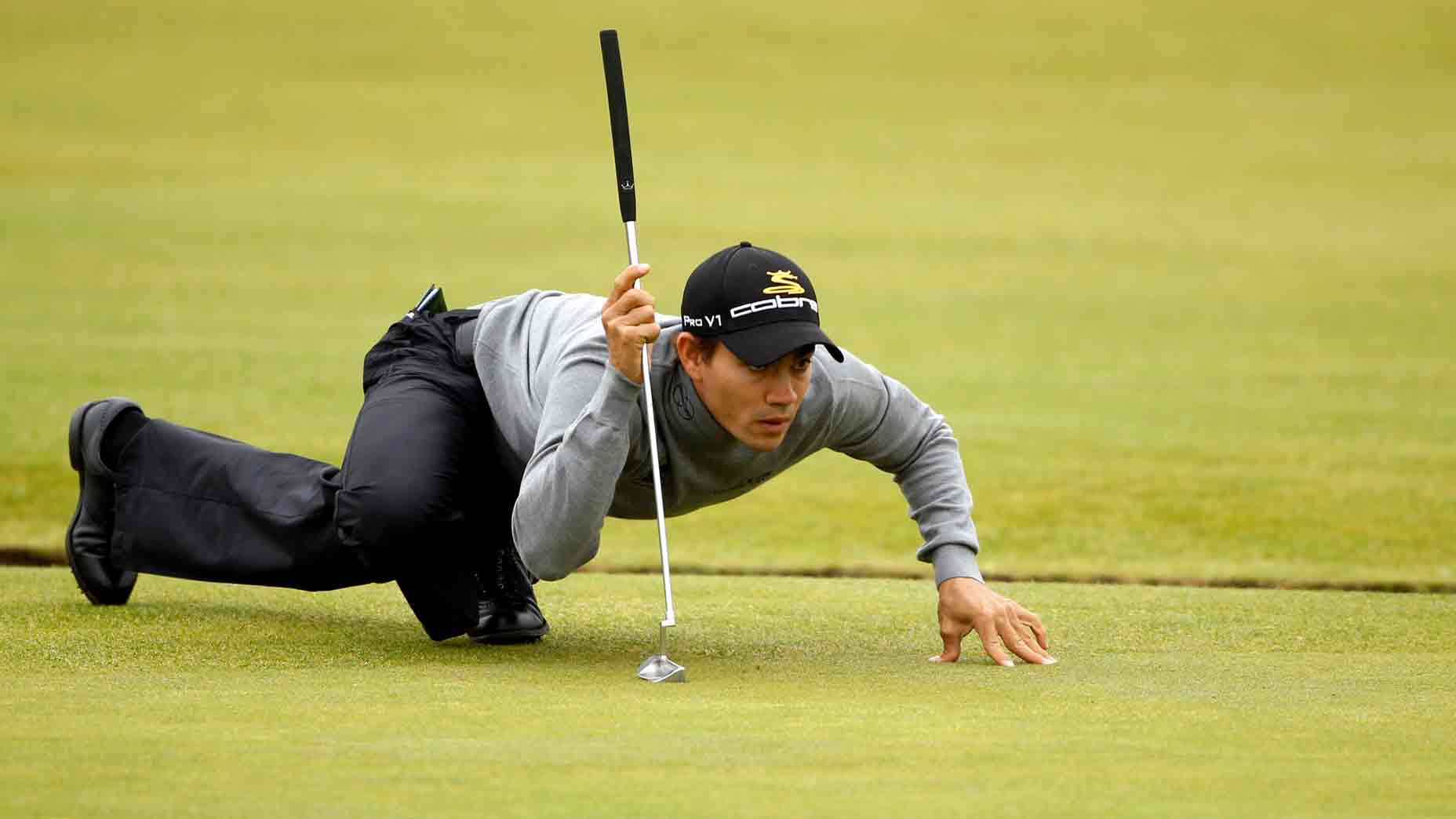
The iconic "Spiderman" stance. Great for Instagram—unreliable for reading greens.
For 100 years, golfers have been told to "get low" and look at the hole. But biology is working against you. Optical illusions, nearby terrain, and the dominance of your visual cortex can distort what you see.
AimPoint Express works because it bypasses your eyes. It relies on proprioception—your body's ability to sense position and balance. Gravity doesn't slump. Gravity doesn't have bad days. By learning to feel slope with your feet, you get a consistent read every single time.
The 3 Core Steps of AimPoint Express

Keegan Bradley using the AimPoint finger method on Tour.
Feel the Slope
This is the foundation. You straddle the line of the putt (usually the midpoint) and determine the tilt of the green under your feet. You assign this tilt a number between 0 and 6 (representing degrees of slope).
- 1%: Subtle break.
- 2%: Average break (most common).
- 3%+: Severe break.
Calibrate Your Aim
Once you have your number (e.g., a "2"), you stand behind the ball. You close one eye and hold up that many fingers (2 fingers) at arm's length. The edge of your finger gives you the exact target to aim at.
Match the Speed
The read is only as good as the speed. AimPoint assumes the ball is rolling at a speed where it would go roughly 1 foot past the hole if it missed. If you hammer it, the break decreases. If you die it in, the break increases.
Why Most Amateurs Fail at AimPoint
Holding up fingers is easy. Managing speed takes practice and maybe a little bit of luck. But feeling the slope is within your control, and is where 90% of golfers struggle.
If you are standing on a 2% slope but your brain thinks it's a 1%, you will aim incorrectly every single time. No amount of finger calibration can fix a bad slope read.
The "Calibration" Problem
Pros are on greens every day. Their feet are calibrated. They do this for their job! For the average golfer who plays once a week, "feeling" a 2% slope is difficult because you have no baseline.
- "Is this a 1 or a 2?"
- "Is this flat or slightly uphill?"
Pro Tip
This is why we built SlopeFeel. You cannot learn to distinguish 1% from 2% by reading about it. You have to feel it.
Ready to calibrate your feet at home?
Check out our KitsHow to Calibrate Your Fingers
Before you take this to the course, you must ensure your arm length matches the finger width.
Find a Level
Use a carpenter's digital level or a phone app to measure slopes.
Find a 2% Slope
Locate a surface that is exactly 2% (or use a SlopeFeel wedge).
Place a Target
Put a tee in the ground (or a coin on the floor) about 10 feet away.
The Test
Stand on the slope. Hold up 2 fingers. Line the edge of your fingers up with the tee.
Adjust
Move your arm closer or further until the other edge lands where the hole would be.
Lock It In
Remember this arm bend. This is your "Calibrated Arm Position."
Common Slopes You Will Face
0-1% (Green Light)
Straight or "inside the cup" putts. Don't over-read these.
1.5 - 2% (Yellow Light)
The most common break on standard greens. If you are unsure, it's probably a 2.
3% (Red Light)
The max for modern greens running at 10+ stimp. Usually found on tiered greens. These feel significant in your ankles.
4%+ (Clowns & Windmills)
If you're feeling this on fast greens, the greenskeeper better hide. Only found on older courses built for 6-stimp greens—or mini golf.
Theory is Good. Feel is Better.
Understanding the math behind AimPoint is the first step. But to lower your handicap, you need to trust your feet.
You can practice the finger geometry anywhere. But to practice the slope perception, you need a reference point.
Ready to calibrate your feet?
Don't wait for Sunday. Train your neural map tonight.
Shop SlopeFeel Wedges